




Best Adjustable Dumbbells UK: Complete Buyer’s Guide
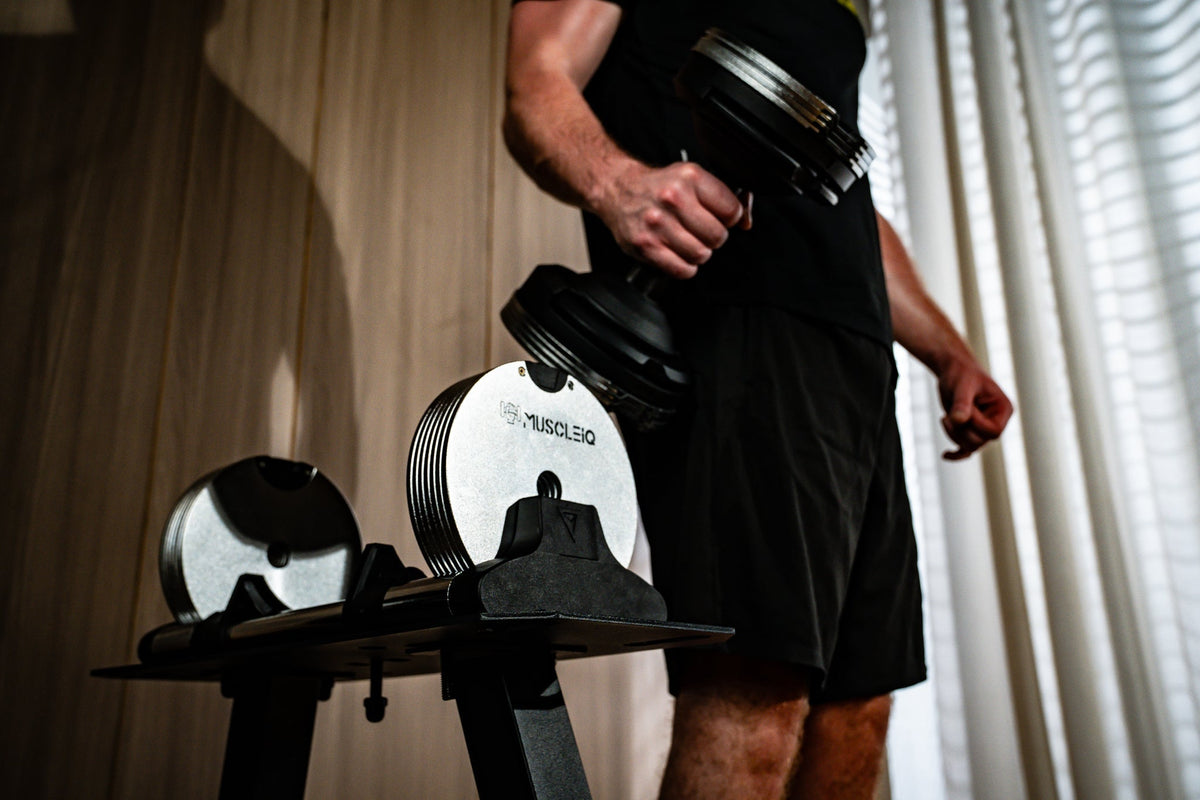
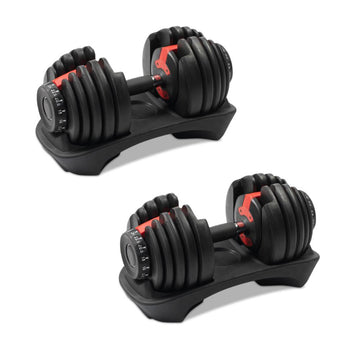
Adjustable dumbbells replace a full rack of fixed weights with one pair that changes load in seconds. The hard part is choosing the right pair. Maximum weight, the size of each weight step and how many settings you get all change how useful a pair will be in a year's time.
This guide compares our adjustable dumbbell pairs, explains what each spec means in real training, and helps you pick the one that fits your goals, your space and your budget. If you want workout ideas once you've chosen, see our 25 best adjustable dumbbell exercises.
Quick answer: which adjustable dumbbells should you buy?
- New to lifting, or training for general fitness: a 24kg pair. It covers presses, rows, curls and lunges for most people for a long time.
- Training regularly and getting stronger: a 32kg pair, so heavy rows, Romanian deadlifts and goblet squats still have room to grow.
- Experienced lifter, or two people sharing one pair: a 40kg or 45kg pair, which keeps heavy lower-body and back work challenging.
- Want the smoothest progression on small muscles: choose small weight steps. Our 1kg increments pair changes in 1kg jumps, and 2kg or 2.5kg steps are the next smoothest. 4kg and 5kg steps suit bigger lifts.
Not sure where you sit? Our adjustable dumbbell weight guide suggests a starting range based on your experience, goal and exercise.
Our adjustable dumbbells compared
Every weight below is per dumbbell. Each product is sold as a pair, so a 24kg pair gives you up to 48kg in total.
| Pair | Weight range | Weight steps | Settings | Best for |
|---|---|---|---|---|
| 24kg Adjustable Dumbbells Pair | 2.5kg to 24kg | 1kg to 2.5kg (uneven) | 15 | Beginners and general fitness |
| 24kg Pair, 2kg increments | 2kg to 24kg | 2kg | 12 | Beginners who want even steps |
| 24kg Pair, 4kg increments | 4kg to 24kg | 4kg | 6 | Simple, fast changes |
| 1kg increments pair, 24kg version | 3kg to 24kg | 1kg | Every 1kg | Small, steady progressions |
| 32kg Pair, 2kg increments | 2kg to 32kg | 2kg | 16 | Intermediate lifters |
| 32kg Pair, 4kg increments | 2kg to 32kg | 2kg, then 4kg | 9 | Intermediate lifters on a budget |
| 1kg increments pair, 32kg version | 3kg to 32kg | 1kg | Every 1kg | Fine progression with room to grow |
| 40kg Adjustable Dumbbells Pair | 5kg to 40kg | 2kg to 3kg (uneven) | 17 | All-round home gym pair |
| 40kg Pair, 2.5kg increments | 2.5kg to 40kg | 2.5kg | 16 | Heavy training with even steps |
| 40kg Pair, 4kg increments | 5kg to 40kg | 4kg to 5kg (uneven) | 9 | Heavy training, fewer changes |
| 1kg increments pair, 40kg version | 3kg to 40kg | 1kg | Every 1kg | Fine progression up to heavy weights |
| 45kg Pair, 5kg increments | 5kg to 45kg | 5kg | 9 | Advanced lifters and heavy legs |
The 1kg increments pair is one product sold in 24kg, 32kg and 40kg versions; choose the version on the product page. Prices and stock change often, and not every version is always in stock, so check each product page for today's price and availability. Several pairs can also be bought with a weight bench or dumbbell stand.
How to choose: the four things that matter
1. Maximum weight
Buy for where you will be in a year, not where you are today. Your legs and back get stronger much faster than your arms, so a pair that feels heavy for curls on day one can feel light for Romanian deadlifts within a few months. As a rough guide:
- Up to 24kg: beginners, toning, general fitness and most upper-body work.
- Up to 32kg: regular lifters who want heavier rows, presses and leg work.
- 40kg or 45kg: experienced lifters, heavier lower-body training, or a pair shared between two people of different strengths.
If you're unsure between two sizes, the heavier pair usually lasts longer. The light settings are still there for shoulder and arm work.
2. Weight steps (increments)
The step is the jump between one setting and the next. It matters most on small muscles. Going from 8kg to 12kg on lateral raises is a 50% jump, which is often too much in one go. On squats or rows the same jump is easy to manage.
A useful way to judge a step is as a share of the weight you're lifting. Going up 1kg from 10kg is a 10% increase. Going up 4kg from 10kg is 40%.
- 1kg steps: the smallest jumps we offer. Best for lateral raises, curls and other small-muscle work, for anyone returning from a break, and for progressing a little at a time.
- 2kg or 2.5kg steps: smooth progression for most exercises, including shoulders and arms.
- 4kg or 5kg steps: fewer, bigger jumps. Quicker to set and fine for bigger lifts, but harder to progress on small muscles.
3. Number of settings
More settings means more choice inside the same range. A 40kg pair with 17 settings lets you fine-tune every exercise. A 40kg pair with 9 settings covers the same range with bigger gaps. The 1kg increments pair gives you a setting at every kilogram across its range. Neither approach is wrong. It depends whether you value precision or fewer, quicker changes.
4. Space and set-up
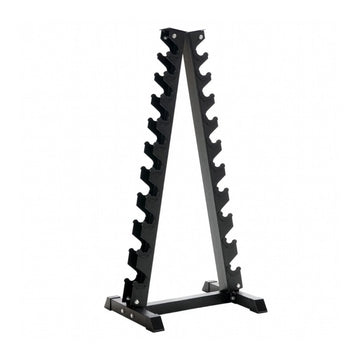
Each pair sits in its own base, so the whole set takes up roughly the floor space of one pair of large fixed dumbbells. A dumbbell stand lifts the bases to a comfortable height, so you're not bending to the floor between sets. Add an adjustable weight bench and you can press, row and support yourself at flat, incline and decline angles.
Which pair for your goal?
| Your goal | Our pick | Why |
|---|---|---|
| Starting out at home | 24kg Adjustable Dumbbells Pair | 15 settings from 2.5kg, enough range for every beginner exercise |
| Building muscle steadily | 32kg Pair, 2kg increments | Even 2kg steps and room to grow on heavier lifts |
| Small, steady progressions or returning from a break | 1kg increments pair | 1kg steps from 3kg, in 24kg, 32kg and 40kg versions |
| One pair for the whole household | 40kg Adjustable Dumbbells Pair | 17 settings from 5kg to 40kg suit lighter and stronger users |
| Heavy leg and back training | 45kg Pair, 5kg increments | The heaviest pair we sell, with quick 5kg changes |
| A complete starter set-up | 40kg Dumbbells and Weight Bench Bundle | Dumbbells and bench together, ready for full-body training |
Adjustable vs fixed dumbbells
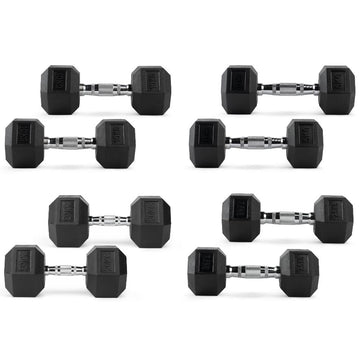
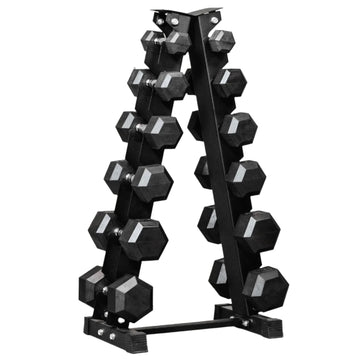
Fixed dumbbells, such as rubber hex dumbbells, are simple and very durable, and they suit drops, quick supersets and busy gyms. They also take a lot of space and money once you own a full range. Adjustable dumbbells give you that range in one compact pair, which is why they're the most popular choice for home gyms. We cover this in more detail in adjustable vs fixed dumbbells.
Looking after your adjustable dumbbells
- Always return the dumbbell fully to its base before turning the dial.
- Don't drop adjustable dumbbells. Lower them under control, as the mechanism isn't designed for impact.
- Train on rubber gym flooring to protect your floor and the dumbbells.
- Keep the bases clean and free of dust so the plates seat properly.
Frequently asked questions
What weight adjustable dumbbells should a beginner buy?
Most beginners do well with a 24kg pair. It's light enough for shoulder and arm exercises and heavy enough for squats, lunges and rows for a long time. If you already train, or you know you want heavier leg work, look at 32kg.
Is 24kg enough for adjustable dumbbells?
For general fitness, toning and most upper-body training, yes. Stronger lifters usually outgrow 24kg first on lower-body and back exercises, which is when a 32kg or 40kg pair makes sense.
Are 1kg or 2kg increments better than 4kg increments?
Smaller steps make progress smoother, especially on small muscles like shoulders and arms. 1kg steps add the least weight at a time, and 2kg or 2.5kg steps are a good middle ground. Bigger steps mean fewer settings to cycle through and suit big lifts. If you're unsure, smaller steps are the safer choice.
Can two people share one pair?
Yes. A wider range, such as 5kg to 40kg, covers lighter and stronger users with the same pair. Just remember to reset the weight in the base between users.
Do I need a bench?
You can do a lot without one, including squats, lunges, Romanian deadlifts, rows and standing presses. A bench adds chest presses, incline work and supported rows, so most people add one sooner or later.
Find your pair
Still deciding? Use our weight guide for a suggested range, or browse the full adjustable dumbbells range. Every MUSCLEIQ order comes with free UK delivery, and our team is happy to help on support@muscleiq.co.uk.


